Ultimate Zero-Waste Ultralight Trail Kitchen Checklist: A Backpacker’s Guide to Minimal, Leave-No-Trace Cooking
Introduction
Backpacking enthusiasts increasingly seek methods to reduce waste while maintaining a lightweight cooking system. This guide explains the principles of zero‑waste cooking, outlines essential ultralight gear, and demonstrates how to combine strategy with smart product choices. Readers will learn how to evaluate cookware, plan meals, and adopt practices that leave no trace on the trail. By the end of the article, one will possess a complete checklist ready for any backcountry adventure.
Background and Context
Leave‑No‑Trace (LNT) principles emphasize minimizing environmental impact through careful waste management, fire discipline, and equipment selection. In the backcountry, cooking accounts for a significant portion of pack weight and waste generation, especially when disposable items are used. Understanding material properties such as titanium versus aluminum, and the benefits of reusable containers, empowers backpackers to make informed decisions. Moreover, knowledge of fuel efficiency and water purification methods reduces both pack load and ecological footprint.
Core Components of an Ultralight Zero‑Waste Kitchen
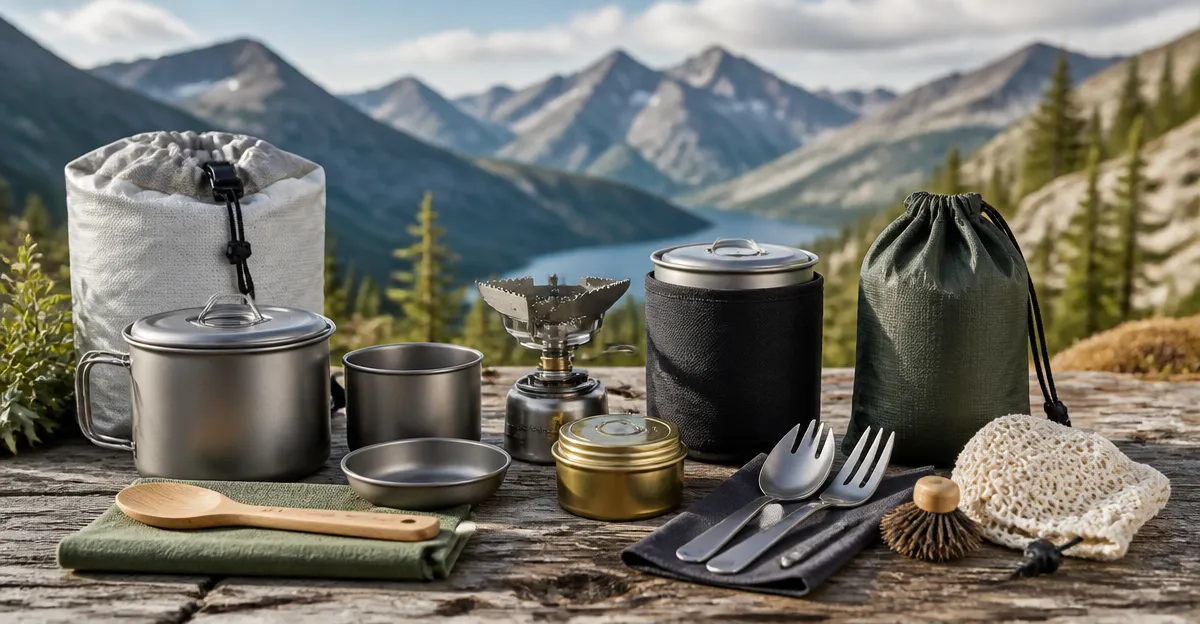
The essential elements of a minimal kitchen include a cooking vessel, a heat source, a utensil set, and a storage solution. Each component should be evaluated for weight, durability, multifunctionality, and ease of cleaning. Selecting items that serve multiple purposes eliminates redundancy and maximizes pack efficiency.
Cooking Vessel
The cooking pot is the heart of any trail kitchen. A high‑quality titanium pot offers unparalleled strength‑to‑weight ratio, resistance to corrosion, and a neutral taste profile. The TOAKS Titanium Pot weighs only 86 g without the lid and provides a 750 ml capacity, making it ideal for solo meals and quick boils. Its internal gradation marks allow precise water measurement, while foldable handles simplify packing.
Heat Source
For ultralight cooking, a compact stove that pairs with a titanium pot delivers rapid boil times with minimal fuel consumption. The Odoland Titanium Pot with Stove includes a 1900 W titanium stove, providing efficient heat transfer and a short boil time for dehydrated meals. The integrated spork and mesh bag further reduce the number of separate items a hiker must carry.
Complete Cookware Sets
When cooking for two or three people, a versatile set that combines pots, pans, and tableware can be more convenient than individual pieces. The D LIAN DONG Camping Cookware Set supplies 17 components, including non‑stick aluminum pots, stainless‑steel plates, and ergonomic handles, all packed into a compact bag weighing 2.35 lb. Hard‑anodized aluminum resists scratches and distributes heat evenly, while the included carrying bag streamlines organization.
Comparison and Selection Guide
| Feature | TOAKS Titanium Pot | D LIAN DONG Cookware Set | Odoland Pot with Stove |
|---|---|---|---|
| Weight (pot only) | 86 g (3 oz) | ~1.1 kg total set | 192 g (6.77 oz) |
| Capacity | 750 ml | Multiple pots (up to 2 L total) | 750 ml pot + 1900 W stove |
| Material | Pure titanium (uncoated) | Hard‑anodized aluminum & 304 stainless steel | 99.9 % pure titanium |
| Additional Items | Mesh storage sack | Plates, cups, knives, fork, spatula, towel, bag | Spork, mesh bag |
| Rating | Not provided | Not provided | 4.7/5 (103 reviews) |
| Price | Not provided | Not provided | $44.99 |
Backpackers should match their group size, cooking style, and weight budget to the appropriate option. Solo hikers who prioritize minimal weight will benefit most from the TOAKS or Odoland solutions, while small groups may find the D LIAN DONG set more convenient despite its higher weight.
Best Practices & Tips for Zero‑Waste Cooking
- Plan meals that use dehydrated ingredients to reduce packaging waste and cooking time.
- Carry a small, reusable silicone bag for scraps; compress and pack out all food residues.
- Use a pot lid to conserve fuel and shorten boil time, thereby reducing emissions.
- Clean cookware with a biodegradable sponge and a minimal amount of water; scrape food particles into a sealed bag.
- Opt for fuel canisters that are recyclable and store them in a dedicated, leak‑proof container.
- Consider a multi‑purpose utensil, such as the spork included with the Odoland set, to replace separate spoon and fork.
- When possible, harvest fire‑safe twigs for a small campfire and use a windscreen to improve stove efficiency.
Frequently Asked Questions
- What is the advantage of titanium over aluminum for a cooking pot?
- Titanium is lighter, does not impart metallic taste, and resists corrosion, making it ideal for long‑term backcountry use.
- Can I use a titanium pot on an open flame?
- Yes, pure titanium tolerates direct flame, but using a stove improves fuel efficiency and reduces fire impact.
- How do I minimize water usage when cleaning on the trail?
- Scrape food residue into a sealed bag, use a small amount of water in the pot, and wipe the interior with a reusable cloth.
- Is the D LIAN DONG set suitable for high‑altitude cooking?
- The hard‑anodized aluminum pans distribute heat evenly, but at extreme altitudes a dedicated stove such as the Odoland model may be required for reliable boil.
- What should I do with leftover fuel canisters?
- Allow the canister to fully depressurize, then recycle it according to local regulations or return it to a participating retailer.
Conclusion
The combination of strategic planning, lightweight materials, and disciplined waste management creates a truly zero‑waste ultralight kitchen. By selecting the appropriate cookware—whether the single‑pot simplicity of the TOAKS Titanium Pot, the comprehensive suite offered by the D LIAN DONG Cookware Set, or the integrated stove solution from Odoland—backpackers can reduce pack weight while adhering to Leave‑No‑Trace ethics. Implementing the best‑practice tips ensures that every meal leaves the environment as pristine as it was found.
Products Featured in This Guide
TOAKS Titanium Pot
Price: Not provided | Rating: Not provided
Featured because its ultralight 86 g titanium construction provides a 750 ml capacity, internal measurement marks, and a foldable handle, making it the benchmark for solo ultralight cooking.
D LIAN DONG Camping Cookware Set
Price: Not provided | Rating: Not provided
Featured for its all‑in‑one 17‑piece kit that includes hard‑anodized aluminum pots, stainless‑steel tableware, and ergonomic handles, providing a comprehensive solution for small groups.
Odoland Titanium Pot with Stove
Price: $44.99 | Rating: 4.7/5 (103 reviews)
Featured because it combines a 750 ml titanium pot, a 1900 W titanium stove, and a spork in a single package, delivering a complete ultralight cooking system with high fuel efficiency.