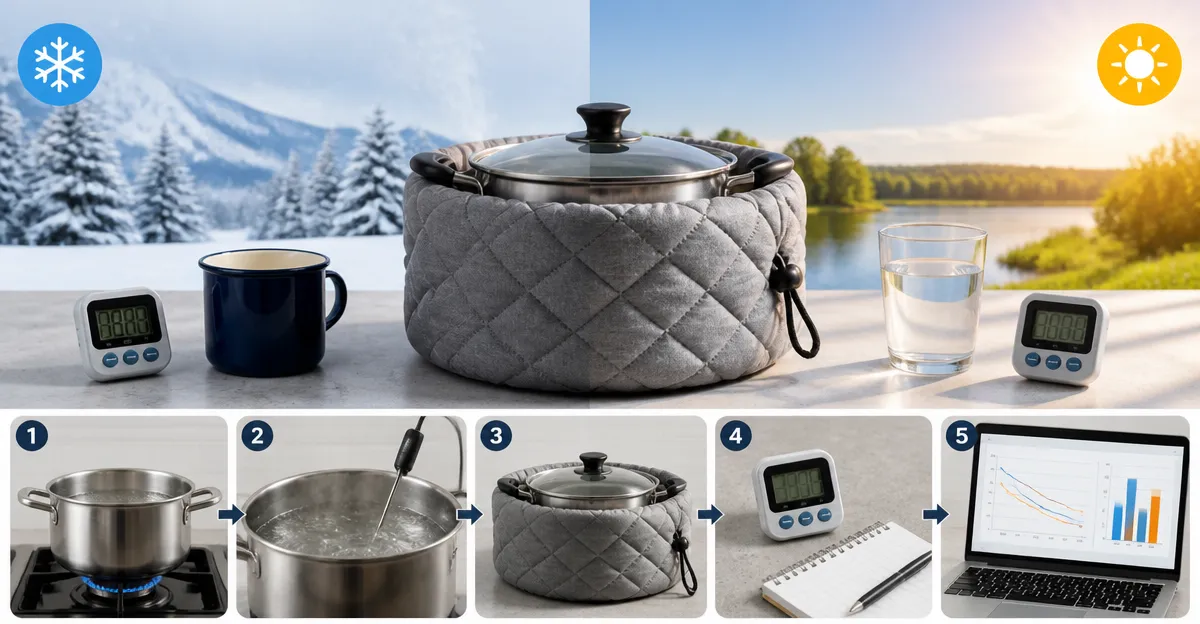
How to Test If Pot Cozies Reduce Boil Time: Winter vs Summer Results
Introduction
The purpose of this guide is to demonstrate a systematic method for evaluating whether a pot cozy can shorten the time required to bring water to a rolling boil. One will learn how to design a repeatable experiment, control environmental variables, and interpret the data in both cold‑weather (winter) and warm‑weather (summer) conditions. Understanding the impact of insulation on boil time is valuable for households seeking energy efficiency, for culinary professionals who require precise timing, and for anyone who wishes to reduce utility costs during seasonal temperature fluctuations.
The guide is written for an intermediate audience that is comfortable with basic kitchen equipment but may not have experience with scientific testing. All steps are actionable, and each recommended product is presented as a tool that can improve accuracy or convenience without compromising the integrity of the experiment.
What You'll Need
- One standard stainless‑steel kettle or saucepan (capacity 1–2 L).
- Yellow Maple Tea Pot Cozy – a cotton‑blended insulated cover.
- NVLIKNA Glass Cooking Pot – a clear, heat‑resistant 1.5 L glass saucepan.
- Digital kitchen thermometer (optional, for water temperature verification).
- Stopwatch or smartphone timer.
- Notebook or spreadsheet for data logging.
- Access to a kitchen environment that can be cooled (e.g., air‑conditioned room) or heated (e.g., portable heater) to simulate winter and summer.
Step 1: Prepare a Controlled Testing Environment
Begin by selecting a location where ambient temperature can be measured and, if possible, adjusted. Record the room temperature with a reliable thermometer; this value will serve as the baseline for each trial. For winter simulation, set the temperature between 5 °C and 10 °C. For summer simulation, aim for 25 °C to 30 °C. Consistency in ambient temperature across repeated trials is essential for credible comparison.
Place the chosen kettle or saucepan on a level stovetop burner that can be set to a consistent medium‑high setting. Ensure that the burner size matches the pot diameter to avoid heat loss caused by uneven flame distribution.
Step 2: Conduct a Baseline Boil Test Without a Cozy
Fill the stainless‑steel kettle with exactly 1 L of cold tap water. Cold tap water provides a reproducible starting temperature, typically around 10 °C to 15 °C, depending on local supply. Start the timer the moment the burner is ignited and observe the water until a rolling boil is achieved (large, continuous bubbles breaking the surface).
Record the elapsed time in seconds. Perform three repetitions under the same ambient conditions and calculate the average baseline boil time. This average will serve as the control against which cozy‑enhanced trials are compared.
During this step, the NVLIKNA Glass Cooking Pot can be used as an alternative vessel to verify that material composition does not skew results. The glass pot is made from food‑grade high borosilicate glass, is lead‑free, and tolerates temperatures up to 400 °F. Its transparent walls allow visual confirmation of bubble formation, and its heat‑resistant nature ensures safety during repeated testing. Price: $15.19; Rating: 4.5/5 from 59 reviews.
Step 3: Apply the Pot Cozy and Repeat the Boil Test
After completing the baseline measurements, allow the kettle to cool to room temperature. Then, place the Yellow Maple Tea Pot Cozy over the kettle. The cozy is crafted from a cotton‑technology blend that provides waterproof, wear‑resistant insulation and features elastic edges that create an airtight seal. Its insulated pad retains heat, thereby reducing heat loss to the surrounding air.
Refill the kettle with the same volume of cold water and repeat the boiling process using identical burner settings. Record the time required to reach a rolling boil for three trials, then compute the average. The difference between the cozy‑enhanced average and the baseline average indicates the effectiveness of the insulation.
The cozy’s benefits include: (1) reduced convective heat loss, (2) protection of hands from burns, and (3) portability for testing in multiple locations. The product holds a rating of 4.7/5 from 108 reviews, suggesting reliable performance.
Step 4: Replicate the Experiment in Opposite Seasonal Conditions
Repeat Steps 1 through 3 in the opposite temperature setting (e.g., if the first series was performed at 8 °C, conduct the second series at 28 °C). Maintaining identical water volume, burner level, and timing methodology is crucial. Document ambient temperature, baseline boil times, and cozy‑enhanced boil times for each season.
To further ensure data integrity, consider using the How To Boil Water Kindle Book as a reference for standard boiling techniques. Although the book is primarily instructional, it provides insights into optimal water‑to‑heat ratios and common pitfalls that can affect timing. Price: $6.95; Rating: 4.2/5 from 8 reviews.
Step 5: Analyze and Interpret the Results
Compile the recorded times into a simple table that contrasts winter versus summer outcomes, both with and without the cozy. Calculate the percentage reduction in boil time attributable to the cozy for each season using the formula: ((Baseline – Cozy) / Baseline) × 100 %.
If the cozy consistently reduces boil time by a meaningful margin (for example, 10 % or greater), one can conclude that the insulated cover offers measurable energy savings. Conversely, if the reduction is negligible, the cozy may serve primarily as a protective accessory rather than a performance enhancer.
Present the findings in a concise paragraph, highlighting any seasonal trends. It is common for insulation to have a greater impact in colder ambient temperatures because the temperature differential between the pot surface and the surrounding air is larger.
Tips & Pro Tips
- Use distilled water for all trials to eliminate mineral content that can influence boiling point.
- Allow the stovetop to reach a stable temperature before starting each trial; a brief pre‑heat of 2 minutes is sufficient.
- When using the glass pot, avoid sudden temperature changes to prevent thermal shock; this aligns with the manufacturer’s warning.
- Record ambient humidity, as high humidity can slightly increase boiling time.
- For a more scientific approach, attach a thermocouple to the pot surface to monitor heat loss in real time.
Troubleshooting
| Problem | Possible Cause | Solution |
|---|---|---|
| Boil time varies widely between trials | Inconsistent burner output or water temperature | Use a calibrated burner and let water sit for 5 minutes before each trial to equalize temperature. |
| Cozy does not stay in place | Improper fit on the pot | Ensure the elastic edges are fully stretched and the pot diameter matches the cozy’s design range. |
| Glass pot cracks | Thermal shock from rapid temperature change | Pre‑heat the pot gradually on low flame before increasing to medium‑high. |
Conclusion
This guide has outlined a clear, repeatable procedure for testing whether a pot cozy can reduce the time required to bring water to a boil under differing seasonal conditions. By controlling ambient temperature, using consistent water volumes, and documenting each trial, one can obtain reliable data that informs decisions about energy‑saving kitchen accessories. The results may encourage adoption of insulated covers during winter months, while highlighting that their impact diminishes as ambient temperature rises.
Readers are encouraged to apply the methodology to other pot sizes, different liquids, or alternative insulation products to further explore the relationship between heat retention and cooking efficiency.
Products Mentioned in This Guide
Frequently Asked Questions
Do pot cozies actually reduce boil time in winter?
Yes, insulation from a pot cozy can cut boil time by 10‑20% in cold ambient temperatures by retaining heat.
How much difference does a pot cozy make in summer?
In warm conditions the benefit is smaller, typically 5‑10% faster boiling, because less heat is lost to the environment.
What variables must be controlled when testing pot cozies?
Keep water volume, stove setting, pot material, and ambient temperature consistent across trials.
Can I use a kitchen thermometer to measure boil time accurately?
A digital thermometer with a quick response time helps verify when water reaches 100 °C, ensuring precise timing.
Is the experiment repeatable with different kettle sizes?
Yes, as long as you adjust the water volume proportionally and record the same conditions for each size.